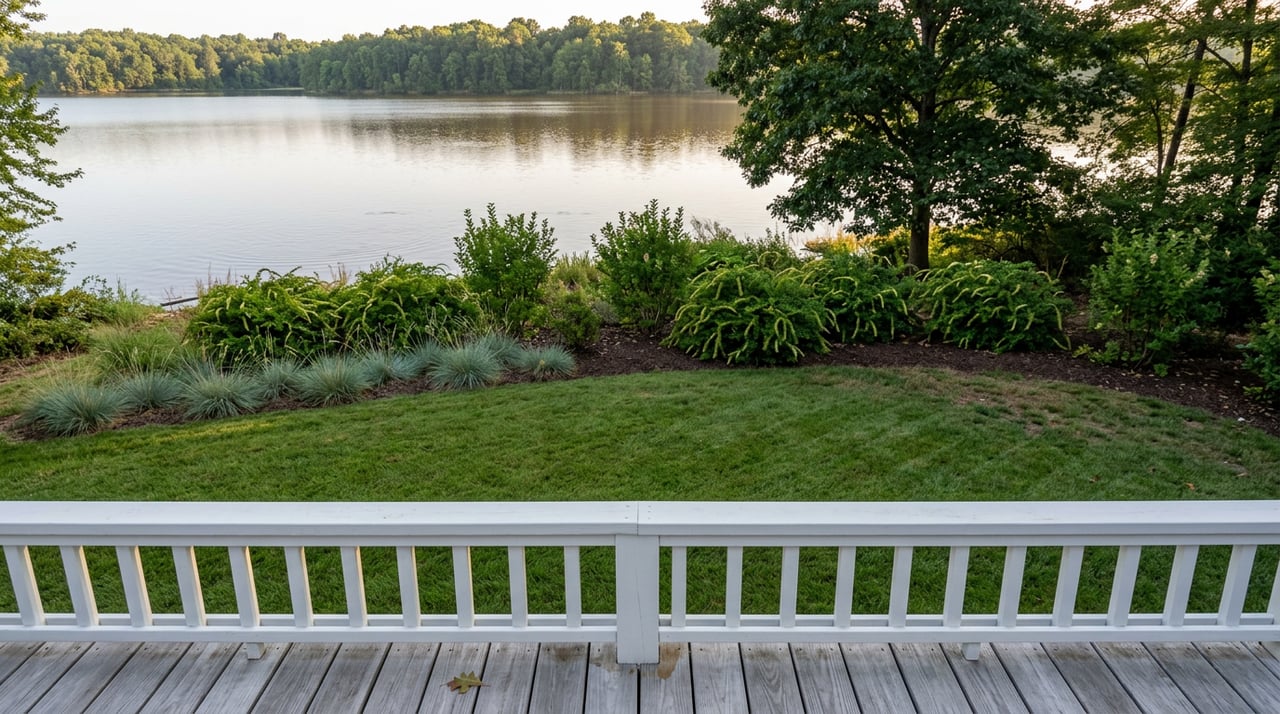
In late July 2022, the caution tape went up at Patriots Park. Coventry Lake, the town's center of summer life since a trolley line first carried visitors out from Willimantic, had just posted its first blue-green algae closure in its recorded history. Public beaches shut down for a minimum of three weeks. Pontoon boats sat tied to docks instead of circling the water. "This is our go-to to stay cool," Coventry resident Jason Patch told a local news crew that week, standing near a lake he could no longer swim in.
Most people who remember that summer think of it as a weather story: a heat wave, warm water, a bloom that eventually receded. It was also something else. It was the moment the town's quiet, long-running effort to manage what happens along Coventry Lake's shoreline became visible to everyone who lives there, and to anyone thinking about buying in.
That distinction matters more to a waterfront buyer than most listing sheets suggest. A previous look at Coventry Lake covered the different kinds of deeded lake access buyers run into here. This one is about something that shapes value just as directly and gets far less attention: how much room a shoreline lot actually has to grow, and who decides that.
The Deed Gets You In. The Buffer Decides What You Can Do Next.
Buyers tend to assume that once they own lake frontage, the only real constraint on renovation is budget. In Coventry, that is not how it works. The Town's Inland Wetlands and Watercourses regulations require review for any regulated activity within 150 feet of Coventry Lake. That is not a suggestion or a best practice. It is the trigger that determines whether an addition, a new septic field, a cleared sightline, or a rebuilt dock needs a permit before a shovel goes in the ground.
Most people who have shopped for lake property elsewhere assume the standard buffer is around 100 feet, because that is the figure the state's own legislative research office cites as Connecticut's general guidance for wetland buffer areas. Coventry set its own number higher. Fifty feet does not sound like much until it is the difference between a footprint that can expand toward the water and one that cannot.
Here is how that comparison actually breaks down:
| Standard | Buffer distance | Who sets it |
|---|---|---|
| Connecticut's general guidance | 100 feet | State recommendation, cited by the legislature's research office |
| Coventry Lake | 150 feet | Coventry's own Inland Wetlands Agency |
| Burlington, CT (a documented outlier) | 650 feet | That town's own Inland Wetlands Agency |
The range is the point. Connecticut does not set one statewide number for lake buffers. Each town's wetlands agency draws its own line, and Coventry drew its wider than the state default. A lot that looks buildable based on a generic 100-foot rule of thumb may not be, once you check the actual regulation for this specific lake.
Why the Buffer Is Enforced More Than Buyers Expect
The 150-foot line is not decorative. It is the mechanism a small, standing group of residents actually uses to shape what gets built. The Coventry Lake Advisory and Monitoring Committee, known locally as CLAM, exists to collect and share information with the town on how to preserve Lake Wangumbaug and its watershed, and it was already active well before the 2022 closure, not a reaction to it. The committee is not a symbolic body. It is the group whose recommendations feed directly into how the town's wetlands and zoning agencies treat proposals near the shoreline.
Backing that committee's work is Dr. Robert Kortmann, a water quality consultant who has presented lake data at Coventry's annual State of the Lake Forum and now advises the town's Inland Wetlands Low Impact Development work group. That group exists because of a mechanism UConn marine science professor Dr. Senji Lin explained plainly after the 2022 bloom: fertilizer and runoff feed the same algae that shut down the beaches, and as he put it, the nutrients driving these blooms usually come from human activity around the shoreline. Every lawn, septic field, and cleared buffer strip along Coventry Lake is a small contributor to that equation, which is exactly why the town treats the 150-foot zone as something to actively enforce rather than a line on an old map.
This is the part a buyer's inspection often misses. A septic system near the water is not just a functional question about pumping and leach fields. It sits inside a zone the town is actively monitoring because of a documented water quality event, with a named committee and a named scientist attached to the response.
Where This Is Headed in 2026
The town has been working toward adopting a formal Lake Management Plan for Coventry Lake within the 2026 calendar year. What that plan will specify in its final form is not yet public. What is public is the direction: a town that already set its shoreline buffer wider than the state default, that has run a standing lake advisory committee for years, and that is now building out a Low Impact Development framework with an outside water quality consultant, is not a town heading toward looser shoreline rules.
For a buyer weighing a Coventry Lake property against something comparable elsewhere in eastern Connecticut, that trajectory is worth pricing in now, while the current regulation is still the known one. Waiting until after a plan adopts to ask what it allows is waiting until the answer is already fixed.
Questions Worth Asking Before You Write an Offer
- How close is the existing structure to the 150-foot line, and is it grandfathered at a footprint larger than what a new build would be allowed today?
- Has the property, or a neighboring one, ever gone through Inland Wetlands Agency review for a dock, addition, or septic upgrade? Ask to see that file.
- Where is the septic system relative to the shoreline, and when was it last inspected or pumped?
- Has this section of shoreline had any algae advisories on record, beyond the 2022 lake-wide closure?
- What buffer plantings or erosion controls already exist on the lot, and would they satisfy a future Low Impact Development standard?
None of these questions show up on a standard listing sheet. All of them affect what the lot is actually worth to you, five years and one renovation project from now.
A Few Quick Answers
Does the 150-foot rule apply to landscaping, not just construction? Clearing vegetation, regrading, or adding impervious surface like a patio within that zone can qualify as a regulated activity. It is worth checking with the Town before assuming routine yard work is exempt.
Is Coventry Lake unusual in having a stricter local buffer than the state guidance? Not entirely. Burlington's 650-foot buffer shows other Connecticut towns have gone even further. What is consistent is that each town's Inland Wetlands Agency sets its own number, so the state's 100-foot figure is a floor, not a promise.
Will the algae closure from 2022 happen again? There is no way to predict that with certainty. What is documented is that it was the lake's first closure of that kind, that the town's existing advisory committee and monitoring work continued and expanded afterward, and that warmer water and nutrient runoff are the conditions scientists point to as drivers.
Coventry Lake still delivers what it always has: real frontage, real recreation, and a shoreline community that has been drawing people back to it since the trolley line from Willimantic. What has changed is how closely the town is watching what happens along that frontage, and buyers who understand the buffer before they fall in love with the view are the ones who avoid an expensive surprise later.
If you are weighing a Coventry Lake property and want a straight answer on what a specific lot can and cannot do under the current rules, Era Blanchard & Rossetto works this shoreline regularly and can walk the regulation with you before you write an offer. Let's talk about your goals.